Nanowire-Templated Back-Electrodes for High-Performance Solar Cells

Research Project funded by the "Executive Unit for Financing Higher Education, Research, Development and Innovation" (UEFISCDI), Romania, under the grant agreement: TE 115/2020 (Code: PN-III-P1-1.1-TE-2019-0868)
Implemented within "Research and Development Center for Materials and Electronic & Optoelectronic Devices" (MDEO), Faculty of Physics, University of Bucharest, Romania
Project time-frame: 24 months (15/09/2020 - 14/09/2022)

In Brief...

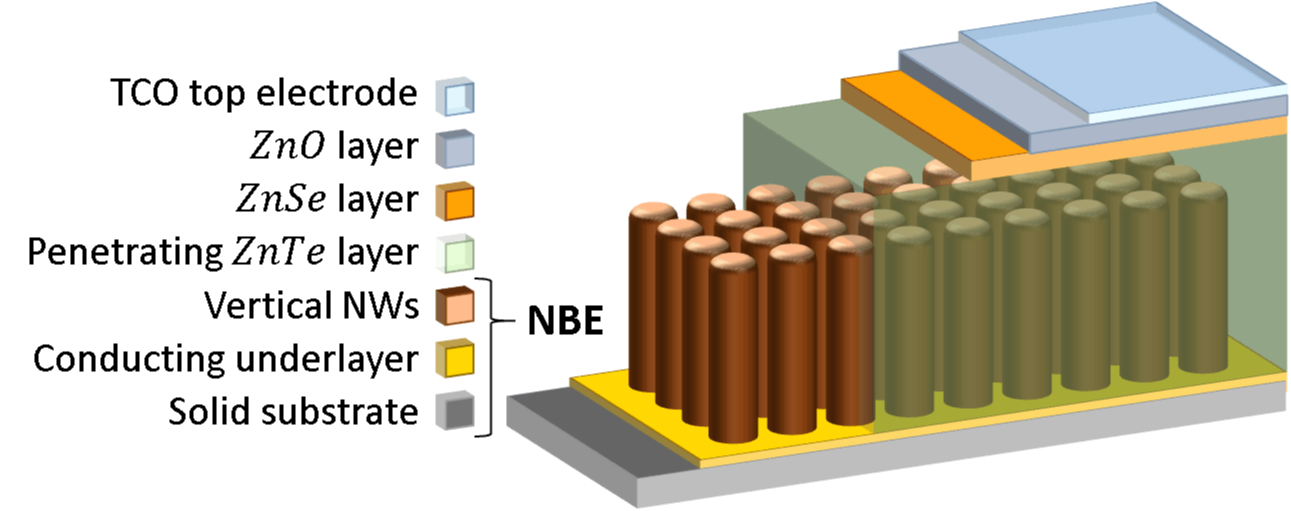
NANODELL deals with some of the yet remaining challenges related with the "Second Generation" of solar cells based on semiconducting A(II)-B(VI) heterojunctions, namely the improving of charge collection efficiency by smartly re-configuring the cell architecture. In this context, a novel “substrate”-type cell design relying exclusively on non-toxic chalcogenide Zn-based compounds is thereby proposed, that owns nanostructured electrodes for improving the collection efficiency of the photo-generated charge carriers.

The technological novelties approached by NANODELL open an outstanding pathway towards large-scale integrability and manufacturing, not only of more efficient photovoltaic elements, but of the next generation of modern nanostructured devices, possessing small physical dimensions but extremely high functional surfaces.

Mobirise

Schematic of the novel "substrate"-type photovoltaic cell. NBE stands for a nanostructured back-electrode consisting of a dense array of metallic (Au, Cu or Au:Cu) nanowires (NWs) vertically-standing onto a gold (Au) - coated silicon (Si) substrate. TCO represents the window top-electrode made of an Indium-doped Zinc Oxide (IZO) or Aluminum-doped Zinc Oxide (AZO) thin film.

Ultimate Aim

To investigate the influence of the nanostructured back-electrodes (NBEs) and Transparent Conducting Oxide (TCO) window top-electrodes on the performance of “substrate”-type photovoltaic cells based on environmentally-friendly Zn-based semiconducting A(II)-B(VI) thin film heterojunctions.

Through the knowledge accumulated across NANODELL's implementation, the ultimate goal is to obtain a NBE-based solar cell, at least 20% more efficient than a conventional solar cell configured with the same materials but relying exclusively on thin films (without NBEs).

Specific Objectives

  • (O1) Development of an electrochemical template synthesis platform
    To develop an electrochemical template synthesis platform for the controlled growth of vertically-aligned nanowires (NWs) with easily tunable aspect-ratio and density. The system would be the first one developed in Romania and in particular within MDEO center.
  • (O2) Fabrication of NBEs from metals with different work-function
    To prepare NBEs from metals of different work-function (i.e. Au, Cu and Cu:Au) and to investigate the materials influence, as well as of the NWs density and geometry (i.e. lengths and diameters) on the performance of “substrate”-type A(II)-B(VI) solar cells with the configuration: NBE/ZnTe/ZnSe/ZnO/TCO, where the TCO is made from Indium-doped Zinc Oxide (IZO) or Aluminum-doped Zinc Oxide (AZO).
  • (O3) Optimization of the TCO window top-electrodes
    To investigate the type and optimal thickness influence of the TCO window top-electrodes on the performance of the “substrate”-type A(II)-B(VI) cells with the configuration: NBE/ZnTe/ZnSe/ZnO/TCO, where the TCO is made from IZO or AZO.
  • (O4) Wide dissemination of the scientific outcome                         
    To widely disseminate the obtained results towards both, specialized and non-specialized audience, through publications, conferences and social channels.

© Copyright 2020 AVA. All Rights Reserved.
Last update: 20/11/2022

Set up a site with Mobirise